Ensuring USFR Compliance While Switching to Online Enrollment Forms
by Emily A. Powell, CPA, Senior Associate
Posted on May 1, 2024
 With student attendance reporting being the third largest section of the Auditor General’s Uniform System of Financial Records (USFR) Compliance Questionnaire for Arizona school districts, great focus should be placed on attendance compliance controls by districts across the state. The Arizona Department of Education has released multiple tools to aid with this, such as the standardized Official Notice of Pupil Withdrawal form. However, there is no standard entry form, and it is at the District’s discretion to create a form and procedures to ensure all entries are in compliance with the USFR. Many districts in recent years have shifted from paper enrollment forms to an online enrollment process. There are many benefits to using an online entry form – around-the-clock access from any location with Wi-Fi, increased legibility, reduced environmental impact, privacy of records, etc. However, any change in procedures has the potential to precipitate non-compliance. This article will discuss key factors a district’s online enrollment process should include to ensure continued compliance related to the USFR.
Below are the five student attendance reporting questions related to entries on the USFR Compliance Questionnaire and how the District can ensure compliance with each one.
Student attendance reporting USFR question #14:
The District ensured the student’s name in the student management system matched the name on the legal document on file. A.R.S. §15-828(D).
How the District can ensure compliance:
- Program your online entry form to not successfully process without the upload of a scanned birth certificate or other reliable proof of the pupil’s identity and age.
- Have registrars review all scans to verify they are clear, complete, and legible. While they are reviewing the scan, have them also confirm the entered student name in the District’s student information system (SIS) matches the birth certificate.
- Guarantee through your software that this information is secure, properly backed up, and accessible when requested from an auditor (even after year-end). When the entry forms are printed or electronically downloaded, all information needs to be readable and student names need to be complete.
Student attendance reporting USFR question #15:
The entry date in the computerized attendance system agreed to the entry form and was entered into the attendance system within 5 working days after the actual date of the student’s enrollment. A.R.S. §15-828.
How the District can ensure compliance:
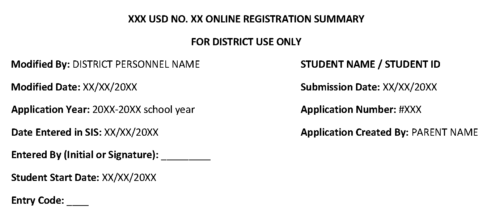
- Create a “for District use only” section on the enrollment form that can only be edited by registrars and/or other SIS They are to input the student entry date and the date the enrollment was entered into the SIS (should be within five days) – and sign off after doing so. They should confirm the entry date in this section matches the student’s entry date in the SIS. See below for an example:
Student attendance reporting USFR question #16:
The student membership begins on the first day of actual attendance or, for continuing/pre-enrolled students, the first day that classroom instruction was offered, provided that the students actually attend within the first 10 days of school. ADE’s External Guideline GE-17.
How the District can ensure compliance:
- While audit support for the above question will not directly appear on an entry form, the District should ensure the SIS attendance record print screen clearly identifies the first day a student began attending classes. This should match their entry date in the SIS. The beginning of each student’s attendance record must be accessible, even after the end of the school year, to pull down for audit review.
Student attendance reporting USFR question #17:
The District obtained and maintained verifiable documentation of Arizona residency for enrolled students, including students in its AOI program. A.R.S. §15-802(B)(1) and ADE’s Updated Residency Guidelines (Please note that proof of residency is not required for homeless students).
How the District can ensure compliance:
- Program your online entry form to not successfully process without the upload of the standardized Arizona Department of Education (ADE) Arizona Residency Documentation form, the standardized State of Arizona Affidavit of Shared Residence form (if necessary – required when a parents or legal guardian does not maintain his or her own residence), and scanned proof of Arizona residency.
- Have registrars review the Arizona Residency Documentation form and proof of residence scan to verify they are filled out correctly, complete, and legible. They should also ensure that the uploaded proof of residency is allowable (see list below).
- Have registrars confirm that the name on the proof of Arizona residency matches the name of the student’s parent/legal guardian. If it does not, they need to verify that the State of Arizona Affidavit of Shared Residence form is filled out correctly (including notarization), complete, and legible.
- Guarantee through your software that this information is secure, properly backed up, and accessible when requested from an auditor (even after year-end). When the entry forms are printed or electronically downloaded, all information needs to be readable and student names need to be complete.
Click below for updated Arizona residency guidelines and fillable forms in English and Spanish:
https://www.azed.gov/policy/updated-residency-guidelines
See below for allowable proof of residency documents (it is the responsibility of the school districts that receive state aid to ensure that student/parent residency information is accurate and verifiable):
- Valid Arizona driver’s license, Arizona identification card
- Valid Arizona motor vehicle registration
- Valid Arizona Address Confidentiality Program authorization card
- Property deed/Mortgage documents
- Property tax bill
- Rental agreement or lease (including Section 8 agreement or off-base military housing)
- Utility bill (water, electric, gas, cable, phone)
- Bank or credit card statement
- W-2 wage statement
- Payroll stub
- Certificate of tribal enrollment (506 Form) or other identification issued by a recognized Indian tribe located in Arizona
- Other documentation from a state, tribal, or federal agency (Social Security Administration, Veterans’ Administration, Arizona Department of Economic Security, etc.)
- Temporary on-base billeting facility (for military families)
- Under A.R.S. § 41-5001(A), school districts and charter schools must accept consular identification cards that are issued by a foreign government as a valid form of identification if the foreign government uses biometric verification techniques in issuing the consular identification card.
Student attendance reporting USFR question #22:
The District excluded nonresident students from the District’s student count and State aid calculations and charged tuition as applicable. A.R.S. §15-823(G) and (L).
How the District can ensure compliance:
- Be ready to discuss the District’s process to identify nonresident students with auditors.
- Consider if this is a situation you want to be supported by your online entry platform. As the instances of nonresident students are rare, it might not be worth the resources to build this out online.
- The District must be able to provide support that nonresident students were excluded from the District’s student count and state aid calculations.
- The District must be able to provide support that nonresident students were assessed a reasonable rate of tuition fixed by the Governing Board. Please note that in some instances, nonresident students may be exempt from tuition (see ARS 15-823 for additional information).
Print-ready version: Click here